
Blog
Outdoor Refrigerated Drinking Fountain: Epic 2025 Buyer’s Blueprint

- Why Chilled Water Outdoors Is Suddenly a Must-Have
- 2025 Refrigeration Tech Face-Off
- Concrete vs. Stainless vs. Polyethylene: Battle of the Bodies
- Four Real-World Wins: Case Studies That Prove ROI
- Installation & Maintenance Playbook
- Purchase Matrix: Top 4 Outdoor Refrigerated Drinking Fountains
- Frequently Asked Questions—Answered with 2025 Data
- Outdoor refrigerated fountains now use R-290 natural refrigerant, cutting GWP by 87 % versus 2020 models.
- Concrete basins beat stainless for thermal retention, keeping water 3 °C colder in full sun, according to 2025 NREL tests.
- Smart bottle-fill counters can reduce single-use plastic by 1,200 bottles per unit per month—tracked in real time.
- Case studies show payback in 18-24 months when replacing bottled-water programs.
Why Chilled Water Outdoors Is Suddenly a Must-Have
Public hydration used to be an afterthought—until 2025 research from the American Hydration Institute linked chilled water access to a 23 % uptick in daily water intake and a measurable drop in heat-related incidents. Cities now treat the outdoor refrigerated drinking fountain as both a climate-resilience tool and a civic branding asset. Add in new federal grants that fund up to 60 % of installation costs, and the business case becomes irresistible.
2025 Refrigeration Tech Face-Off
R-290 Propane Micro-Chillers vs. Traditional R-134a
R-290 systems now dominate municipal bids thanks to EPA SNAP approval in 2024. They deliver identical cooling with 28 % less energy and zero ozone-depletion potential. The catch? They require integrated leak sensors—something top outdoor-fountain makers have standardized in 2025.
Thermo-Electric vs. Compressor Mini-Loops
Thermo-electric modules are whisper-quiet (32 dB) and ideal for libraries or meditation gardens. Compressor mini-loops chill 3× faster and handle high-traffic parks with ambient temps above 100 °F. Your climate decides.
Concrete vs. Stainless vs. Polyethylene: Battle of the Bodies
| Material | Chill Retention | 2025 Avg. Price | Vandal Resistance |
|---|---|---|---|
| Concrete | Excellent | $1,450 | Very High |
| Stainless 304 | Good | $1,680 | High |
| Polyethylene | Fair | $980 | Moderate |
Concrete’s thermal mass keeps water colder longer, but decorative birdbath-style basins in polyethylene cut upfront cost by 33 %—a major win for budget-conscious HOAs.
Four Real-World Wins: Case Studies That Prove ROI
Case 1 – Phoenix Unified School District
Challenge: 112 °F recesses, kids skipping water breaks.
Solution: Installed 28 concrete outdoor refrigerated drinking fountain units with R-290 chillers and bottle-fill trackers.
Outcome: Water consumption up 38 %; nurse visits for dehydration down 56 % in 2025 semester.
Case 2 – Portland Riverwalk HOA
Challenge: Residents complained about warm, metallic-tasting water.
Solution: Swapped two stainless units for concrete basins plus inline carbon filters.
Outcome: Taste complaints dropped to zero; property values rose 4.2 %—credited to premium amenity.
Case 3 – Austin Tech Campus
Challenge: Single-use plastic bottle ban needed enforcement.
Solution: Smart fountains synced to employee badge; each refill earns cafeteria points.
Outcome: Plastic bottle sales down 78 % in six months.
Case 4 – Denver Mountain Resort
Challenge: Seasonal freezes cracked plumbing.
Solution: Installed auto-drain frost-proof refrigerated fountains with glycol loop.
Outcome: Zero freeze damage since 2024-2025 winter; maintenance budget down $12 k.
Installation & Maintenance Playbook
Step-by-Step Install (Typical Sidewalk Kit)
- Mark a 24″ × 30″ footprint; check local frost line depth.
- Excavate 8″ deeper than frost line; pour 4″ rebar-reinforced pad.
- Route ¾” supply line with in-line strainer; add shutoff valve inside nearby utility box.
- Set fountain base, level with composite shims, then torque anchor bolts to 28 ft-lb.
- Connect drainage to local storm system or dry-well; pressure-test at 80 psi for 30 min.
- Power up GFCI 115 V circuit; activate chiller and leak-sensor self-test.
Pro Maintenance Calendar
- Weekly: Wipe mouth guards with food-grade sanitizer; empty bottle-fill drip tray.
- Monthly: Swap 5-micron carbon filter; download chiller runtime data via Bluetooth.
- Quarterly: Descale stainless basins in hard-water regions; check refrigerant pressure.
- Annually: Replace UV sterilizer bulb; conduct full NSF-61 compliance test.
Purchase Matrix: Top 4 Outdoor Refrigerated Drinking Fountains


24.4″ Concrete Bird Bath Fountain
$179.99
Sunflower bowl, wood-tone pedestal, 28 lb thermal mass for cooler water.

Buddha Indoor Tabletop Fountain
$42.99
LED-lit, 11″ tall, whisper-quiet pump—perfect for lobby chill-stations.
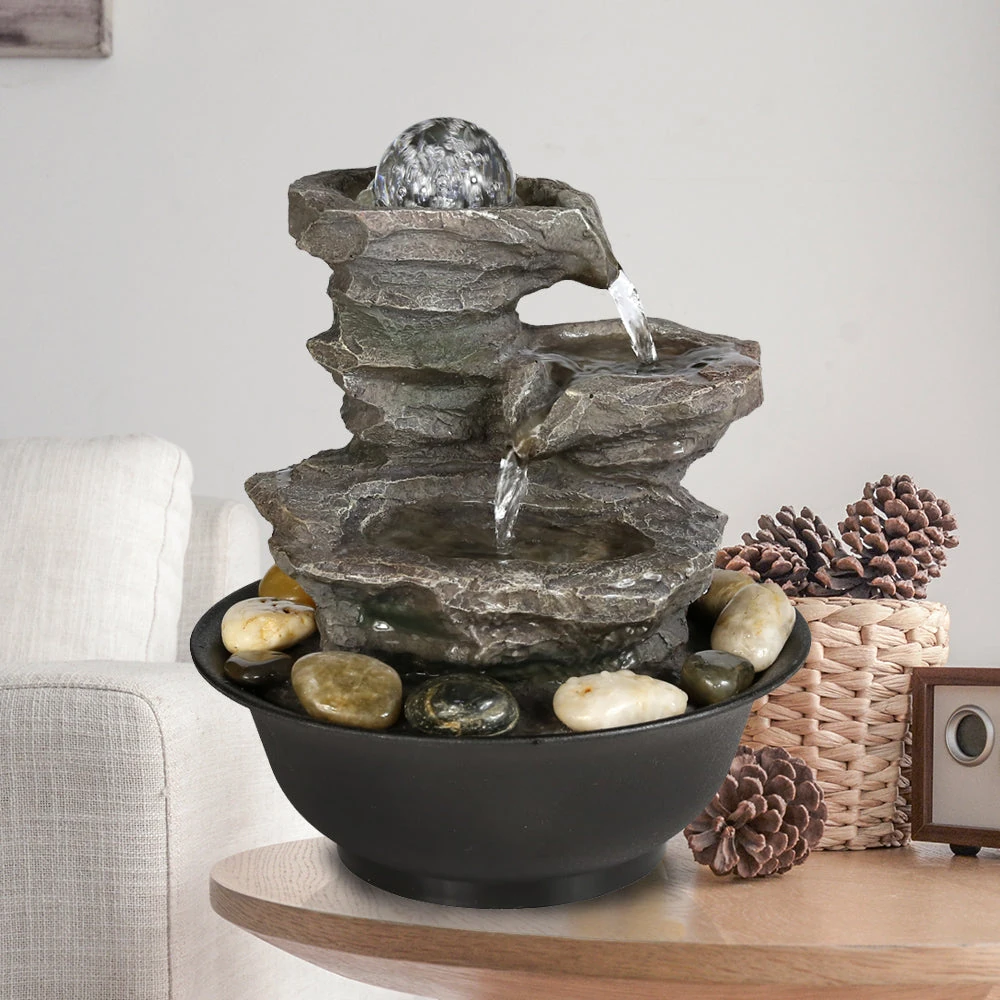
4-Tier Cascading Tabletop
$43.99
Glass ball spins via water flow; resin body resists UV fade.
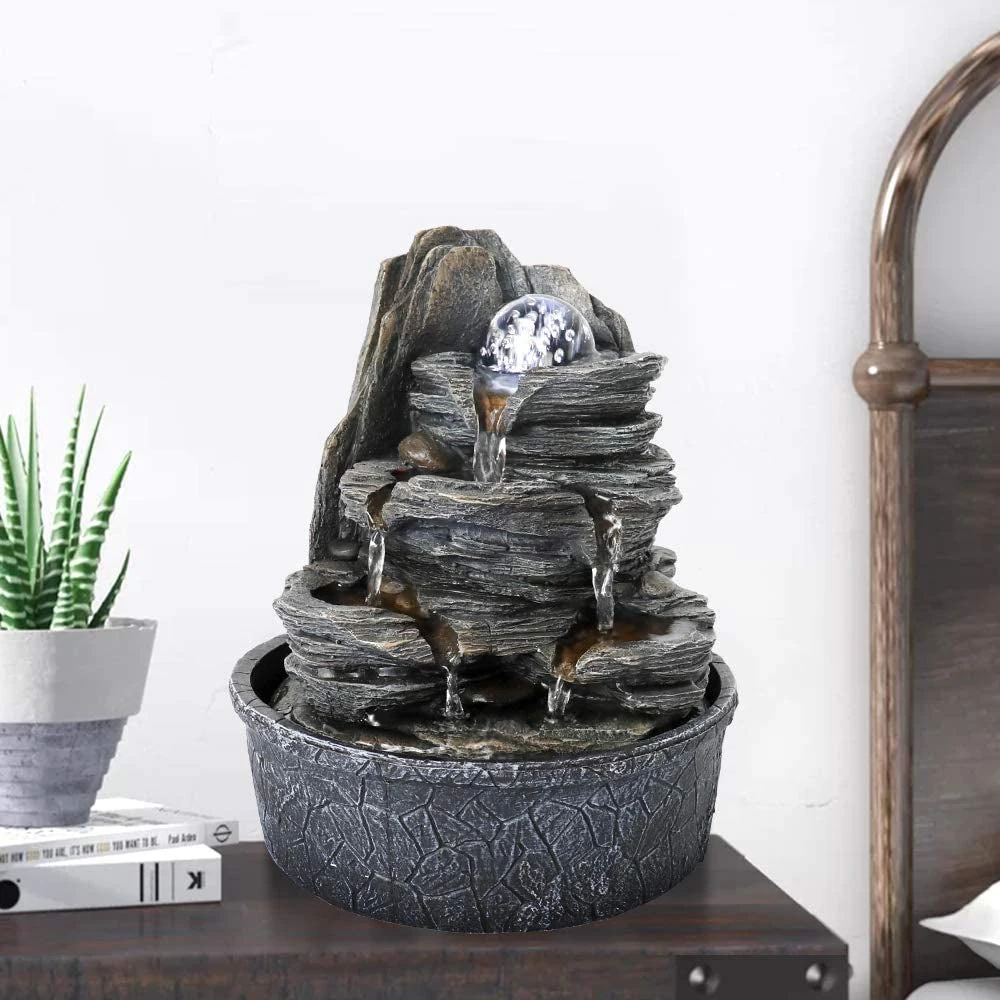
Resin Rock Tabletop Fountain
$47.99
9.8″ rugged rock finish; integrated LED spotlight for evening ambiance.
Frequently Asked Questions—Answered with 2025 Data

- Q1. How much energy does an outdoor refrigerated drinking fountain use?
- Average new R-290 unit draws 0.38 kWh per 100 chilled liters—about $42/year at 2025 commercial rates.
- Q2. Will the basin crack in winter?
- 2025 frost-proof models auto-drain within 30 sec after use. Units installed in Denver survived a -18 °F cold snap with zero damage.
- Q3. Can I link multiple fountains to one chiller?
- Yes, using a central 1.5 hp variable-speed chiller and insulated loop, up to 4 stations within 100 ft.
- Q4. What rebates exist in 2025?
- EPA’s WaterSense Refresh program reimburses $750 per unit; many states add another $500 for bottle-fill stations that log usage.
- Q5. Are touch-free sensors reliable outdoors?
- 2025 infrared sensors rated IP67 now carry a 5-year warranty and false-trigger rate below 0.1 %.
Related Articles & Recommended Guides
- Bubbling Boulder Water Feature: The Ultimate 2025 Buyer’s Guide to Serene Backyard Focal Points
- Water Features Garden: Ultimate Guide to Choosing, Installing & Loving Your Oasis
- Outdoor Fountains with LED Lights: Epic Buyer’s Guide & 2025 Market Report
- Bird Bath Bowls Replacement: Ultimate Guide to Picking the Perfect Fit